The Unlikely Conservationist
Falconers and the New Face of the Ethical Hunter
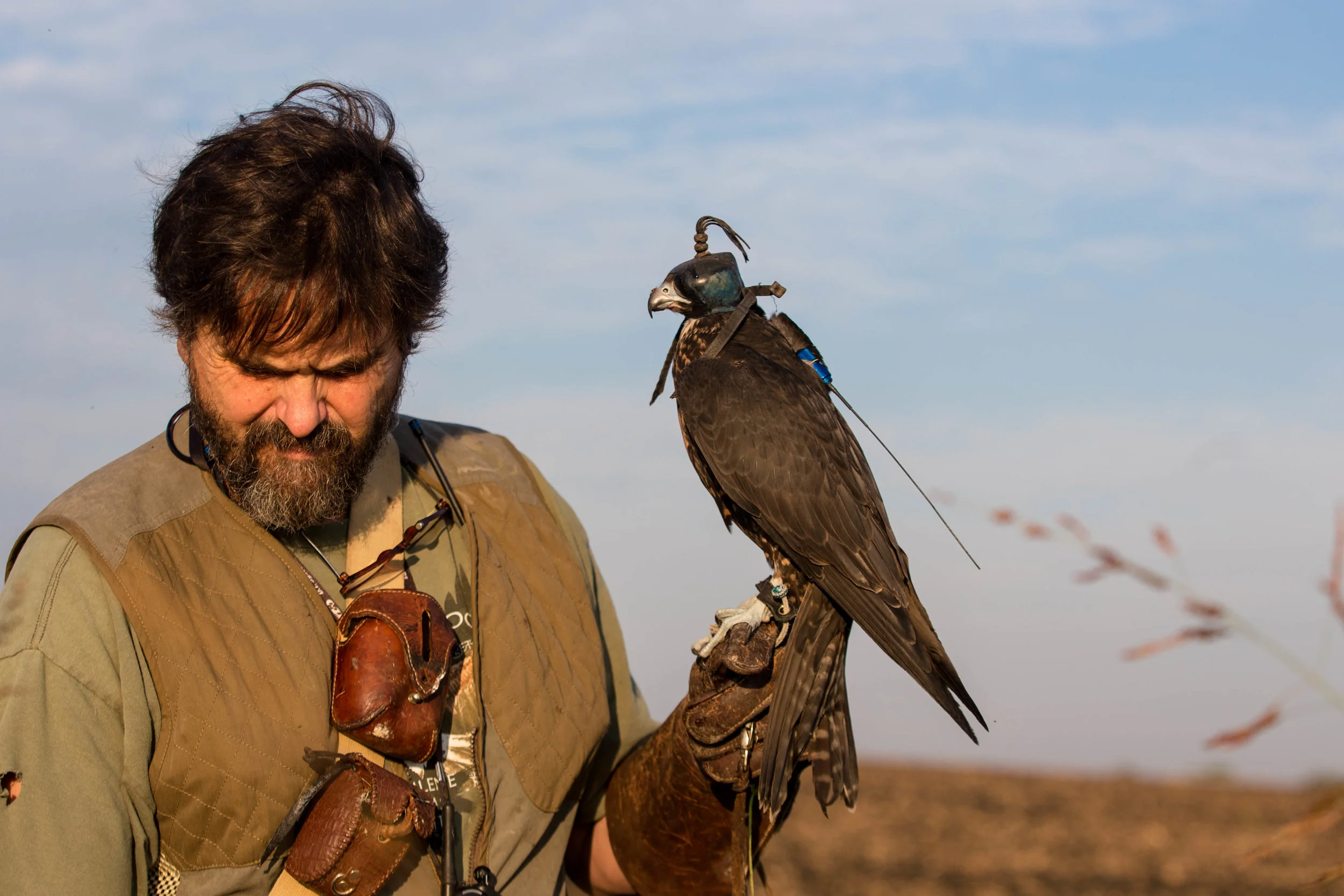
Jeremy Kessler pulls his 4x4 vehicle to the side of a dirt road He checks the GPS screen flashing on the dash, the red beacon we had been chasing now occupies the center of the field.
“This is the spot,” he says in a hurry and jumps out of the vehicle. He holds an IPad in one hand, and uses the other to shield his eyes against the blinding blue of the sky. “There she is,” he says, pointing to a black dot, nearly impossible to make out in the infinite sky.
He pulls a live pigeon out of the leather satchel hanging on his side and lets it fly a few feet in front before pulling back on its tether. Kessler lets out a high-pitched whistle, a sound that’s hard to believe can come from human lips, the high frequency piercing the calm morning. The tethered pigeon flaps in the air helplessly.
In an instant the hawk that had been circling high above had descended at a speed over 100mph and slammed into the pigeon. This dive bomb is called the “stoop,” with some of the fastest clocked at 250mph. The bird catches the pigeon, pinning it to the ground with its blue talons, a sign of the bird’s immature age. “He’s still learning, usually they fly back in, but sometimes, they need convincing, this is the shitty way to get him to come back,” Kessler says as he reaches down to pick up the prairie hawk, a beautiful brown bird with spotted feathers on the chest. It begins to eat the pigeon it just killed.
Kessler stands in the middle of the field wearing a hunting vest while sporting shorts and boots unlaced. He wears a leather satchel on his shoulder holding the tools of the trade, hoods, a spare glove, and a lure to call the bird back to the fist – in this case, Kessler uses live pigeons as lures, but anything fashioned from feathers will often suffice. He holds the bird in his leather glove, talking to it, as if to a child.
He lets it finish half the pigeon. The bird now stands calm on the leather glove cawing greedily for more meat. “Sometimes when you hunt with a hawk, the chase can be over in a matter of minutes. Unless the bird lifts high into the thermals and strays away, then you can spend the rest of the day chasing the bird down.”
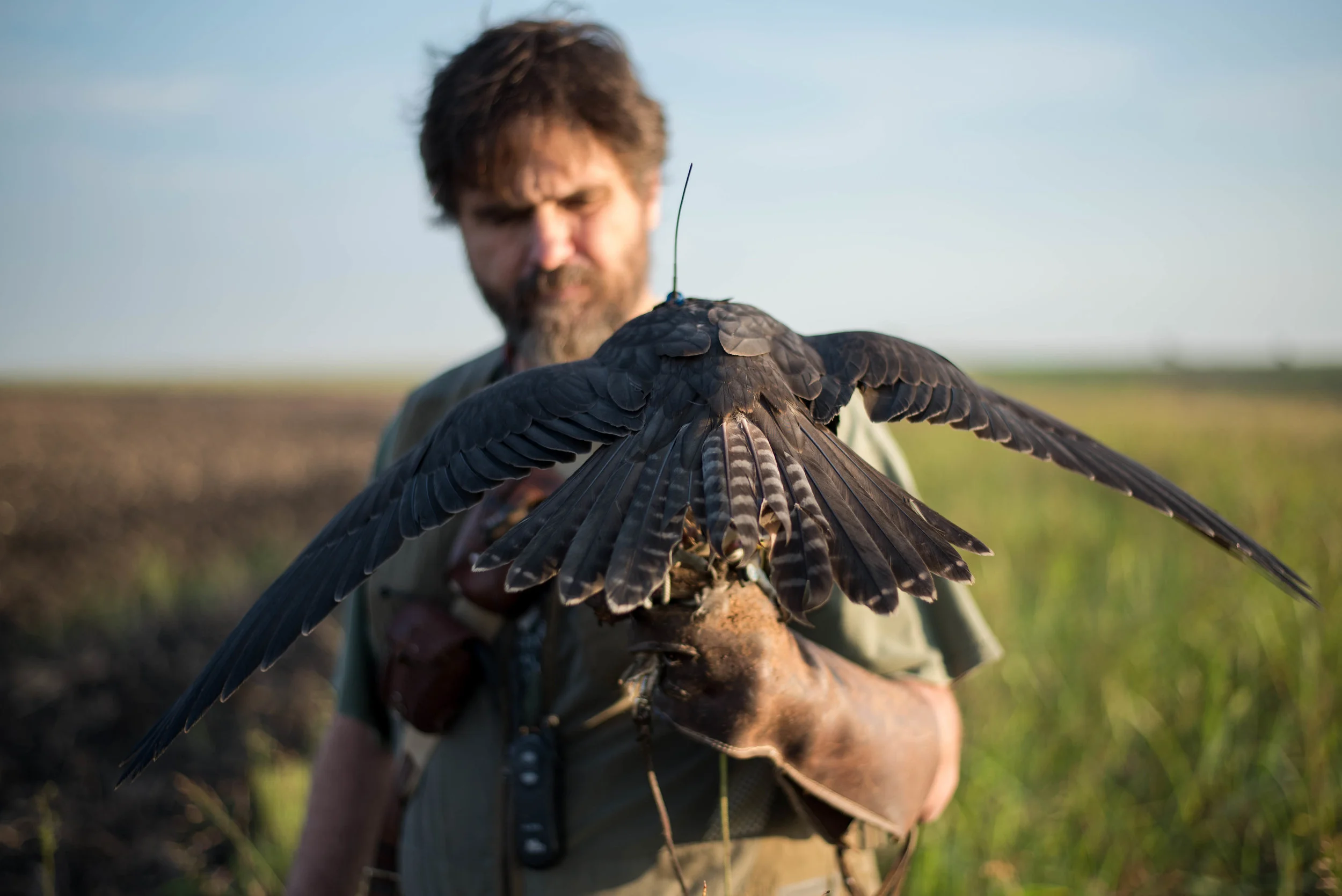
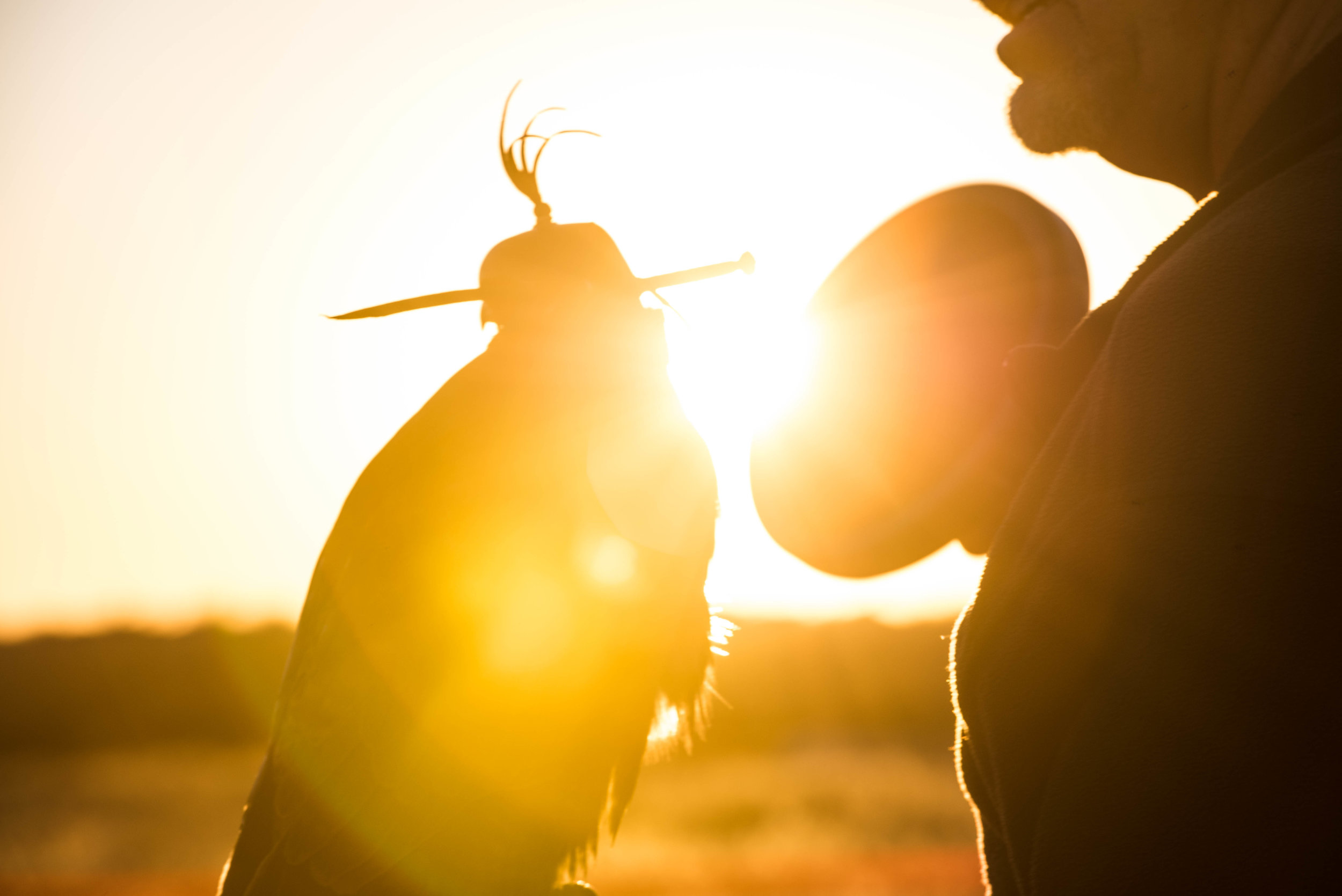
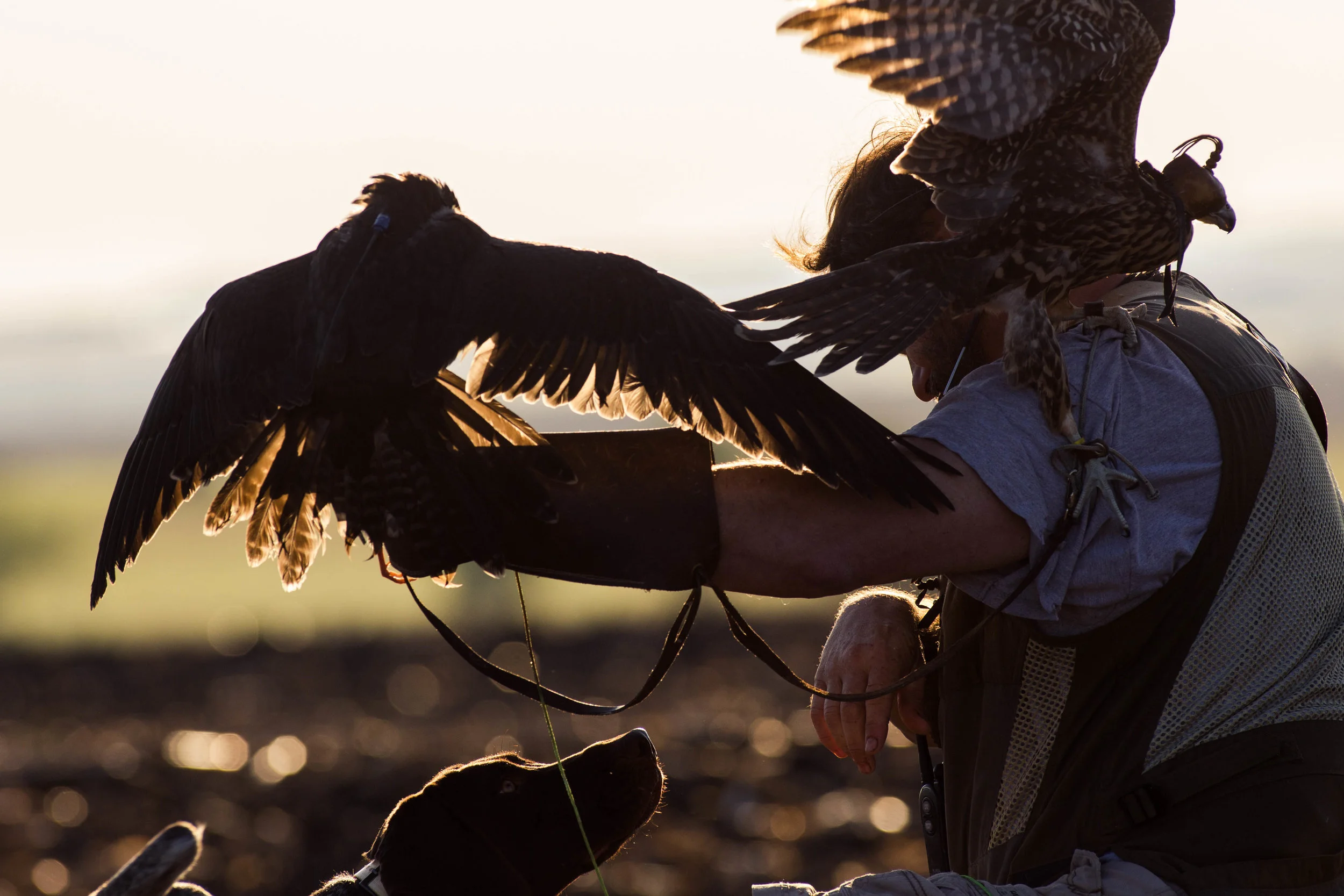
Kessler holds a male hawk in his gloved fist after a hunt. The antennae wire transmits the bird’s location to a portable GPS. Often, hawks damage or break their tail feathers, and a falconer with mend the tail by fixing new feather over the broken ones.
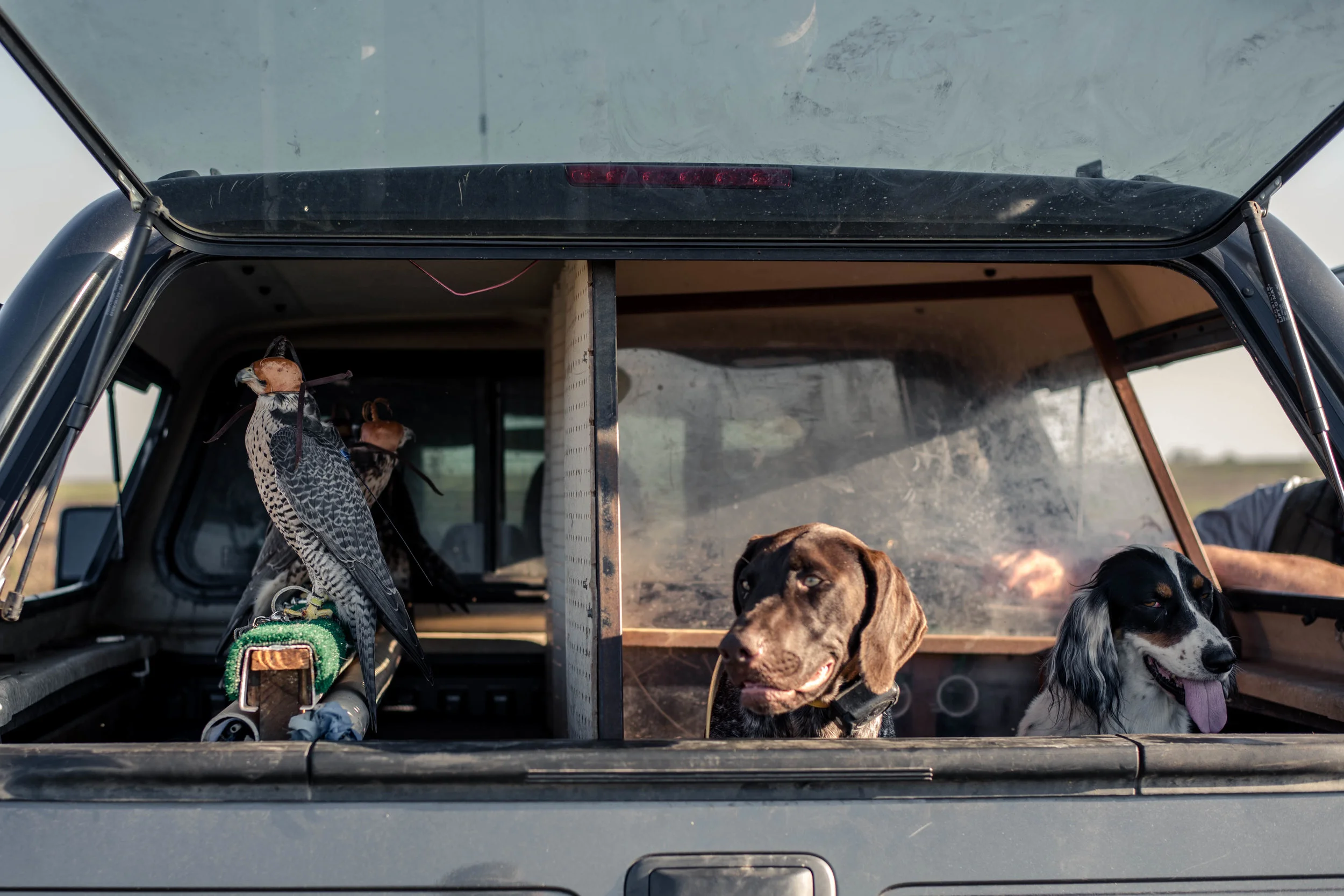
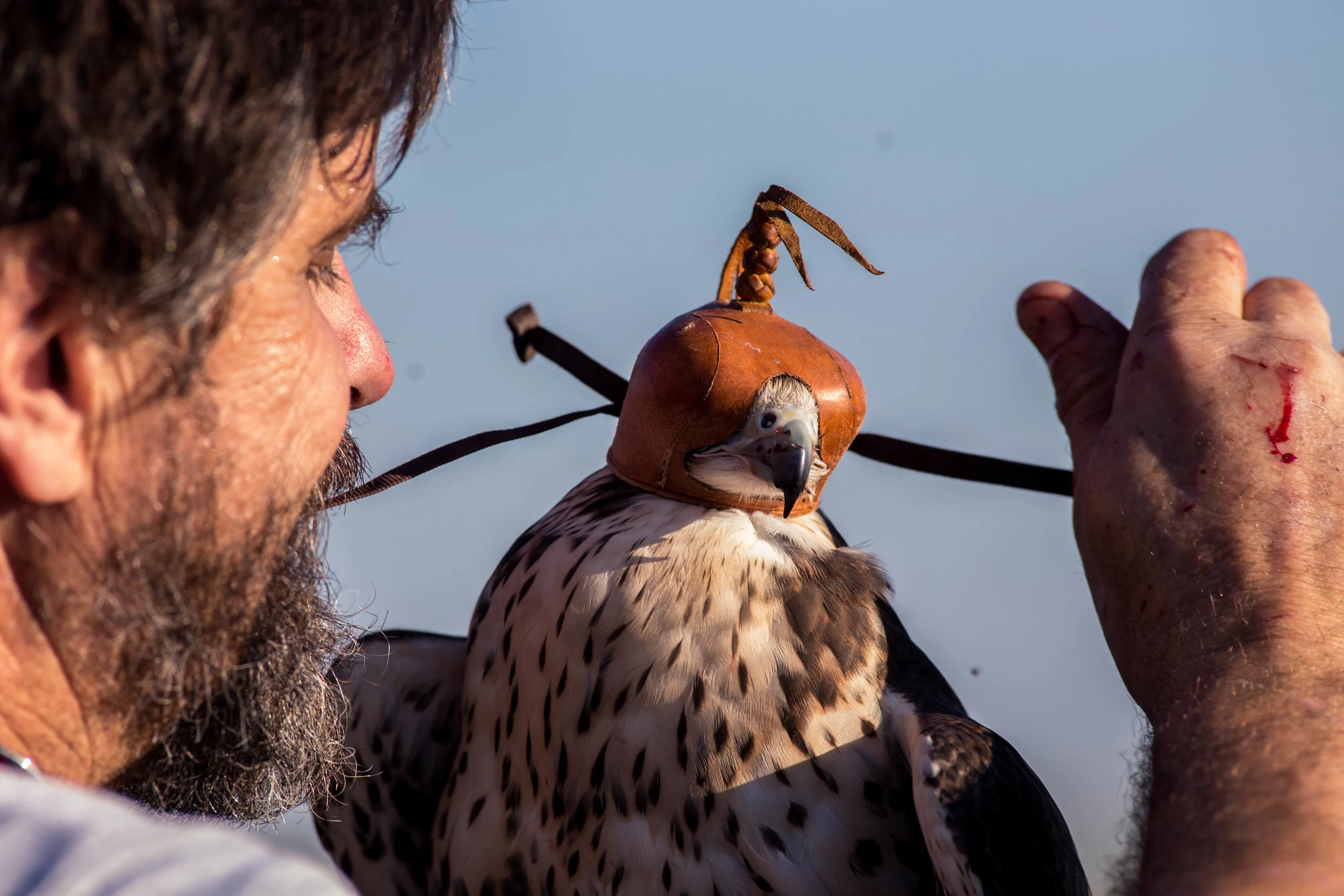
Kessler pulls the leather hood over the bird’s head, and cinches it using his teeth and free hand. The hood is dark brown and in the style of a Dutch hood cover, with a decorative leather plume spouting from the top. Hoods are a simple yet ingenious piece of technology. They block out external stimuli in order to calm the birds, essentially acting as a blindfold. But it is much more humane than the practice of temporarily sewing the bird’s eyelids shut, which was done until sometime around the Crusades. He opens the back of his SUV and places the bird on a homemade perch and ties the jess, a leather band around the leg that is used to tether the bird.
He joins three other hawks, all hooded, waiting for their turn to hunt.
Kessler is a Master Falconer from outside Austin, TX. The term falconer is pretty self-explanatory – it refers to anyone who flies a bird of prey to wild quarry in its natural state. Falconry and hawking are often used interchangeably, regardless of the bird flown, though the common term is falconer. The birds of prey range from eagles, hawks, falcons, and sometimes owls. The type of quarry depends on the bird. In the U.S., falconers predominately use falcons and hawks to hunt small rodents, jackrabbit, and other birds.
After more than a thousand years, and despite recent technological advances, the practice of falconry hasn’t changed much. In the days before GPS, when someone of royalty went out hunting, they had an entourage accompany them to assist in the hunt. Servants would stand on the surrounding hillsides to watch the bird in case it flew away. Today, most falconers mount telemetry units on their birds, small devices that clip onto the back feathers and resemble little blue jetpacks.
After more than a thousand years, and despite recent technological advances, the practice of falconry hasn’t changed much. In the days before GPS, when someone of royalty went out hunting, they had an entourage accompany them to assist in the hunt. Servants would stand on the surrounding hillsides to watch the bird in case it flew away. Today, most falconers mount telemetry units on their birds, small devices that clip onto the back feathers and resemble little blue jetpacks.
Conservation
The development of technology allows falconers to track their birds on hunts, clocking altitude and speed. Kessler says this is just a distraction. “Sometimes guys get into a competition about how high a bird flew, or how fast. That’s not really what it’s about.” But this technology plays an important role in conservation
Laruen McGough, an anthrozoologist and conservationist, says “Falconers have been a driving force to create tiny transmitters that can be used to conduct research on raptors.” McGough is the ED of The Falconry Fund, a nonprofit dedicated to raptor conservation. She also flies a rehabilitated Golden Eagle named Miles, and is one of the few in the U.S. to fly an eagle.
The role hunting plays in conservation is often overlooked or misunderstood. But many hunters (including falconers) are ardent supporters of conservation. They see their role in it as a piece of the food chain. Hunters help cull herd populations and add a balance, while contributing money to administrative costs with the fees they pay.
Conservation plays an important role in falconry and vice versa. “Most falconers would consider themselves conservationists,” McGough says. “Falconry requires natural, healthy habitats, as well as robust and thriving populations of grouse, duck, rabbits, and raptors themselves.” This means that it is in falconers’ best interest to help maintain a healthy ecosystem.
But falconers play a role slightly different than other hunters. Instead of hunting rifles, their tool is a natural predator, trained in a way that directs animal hunting instincts to coincide with what the falconer wants. Maintaining the so-called tools of the trade subsequently means the preservation of a species.
“Falconry techniques are great for the rehabilitation of raptors – raptors have to be successful hunters to survive in the wild, a skill you can hone through flying one in falconry,” McGough says.
This creates a bond between falconer and bird that creates a more nuanced and sophisticated approach to hunting. Whether it’s a hobby or a means of life, falconry represents a primeval component of human evolution that aided in our survival as a species – the ability to adapt our surrounding resources to meet our needs, including using wild animals as hunting aides.
In a changing climate, where several animal populations face displacement or extinction, falconry holds a refuge for not only birds of prey, but their ecosystems. “When land and natural resources are abused, it is usually raptors that are the first to face a decline in populations,” McGough says.
Major threats facing falcons are development, desertification and climate change. Encroachment of human development on hunting grounds increases competition between birds, and places hazards in their environment. Telephone poles, though seemingly harmless, pose a serious threat to falcons –seasoned falconers are sure to steer clear of any power lines. Several organizations are set up to encourage responsible and ethical falconry, as well as promote the preservation of both birds of prey and their ecosystems. In 1970, the Peregrine Fund was set up in North America to preserve falcons – particularly for its namesake, the Peregrine Falcon. Efforts to restore the Peregrine population were marked successful when, in 1999, the Peregrine Falcon was removed from the Endangered Species List.
Falconry in this way represents a key component in preservation – appreciation. Most falconers see the importance that balance plays in the sustainment of delicate ecosystems, but another aspect that drives that motivation is awe at the beauty of the natural. Falconers appreciate the sport and the hunt, and consequently find that it is worth preserving.
An Ancient Practice
Evidence of falconry dates back as far as 3000 BCE, where it developed on the steppes of Central Asia and in Persia. A stone carving portraying some of the earliest evidence of falconry in Tell Chuera, in northeastern Syria, dates back almost 5,000 years. And petroglyphs dating from 3000-2000 BCE in the Altai Mountains of Mongolia depict birds of prey capturing game. Falconry emerged in nearly every corner of the globe, wherever birds of prey inhabit. And with it came admirers from far and wide.
Famed Italian traveler Marco Polo wrote that the Mongolian ruler, Kublai Kahn, “takes with him full 10,000 falconers and some 500 gyrfalcons, besides peregrines, sakers, and other hawks in great numbers." And one of the earliest examples of an attempt at conservation emerged in the ornithological work De arte venandi cum Avibus, written by Frederick II von Hohenstaufen, the Holy Roman Emperor, the King of Sicily and Jerusalem – which has been in print since it was completed in 1241 CE.
Though still practiced throughout the world today, falconry takes various shapes. In the Middle East, the long tradition of falconry emerges as a luxurious hobby. Princes and Sultans in Saudi Arabia fill up all the passenger seats on a commercial plane to transport their numerous birds, showcasing the height of extravagance.
Falconers in the UK fly hawks on the moors, then take to online message boards when neighbors complain about a bird flying too close to their garden. One post reads, “Need some help guys. I had a message from a neighbor who has aggressively said I can't fly my hawks over their house garden…can he do that or is the sky above like no man’s land for nature?” The following comments generate an argument about who is right and who is wrong in this situation, and then quickly and unexpectedly turns into an argument on bird pedigree – something falconers are always keen to discuss.
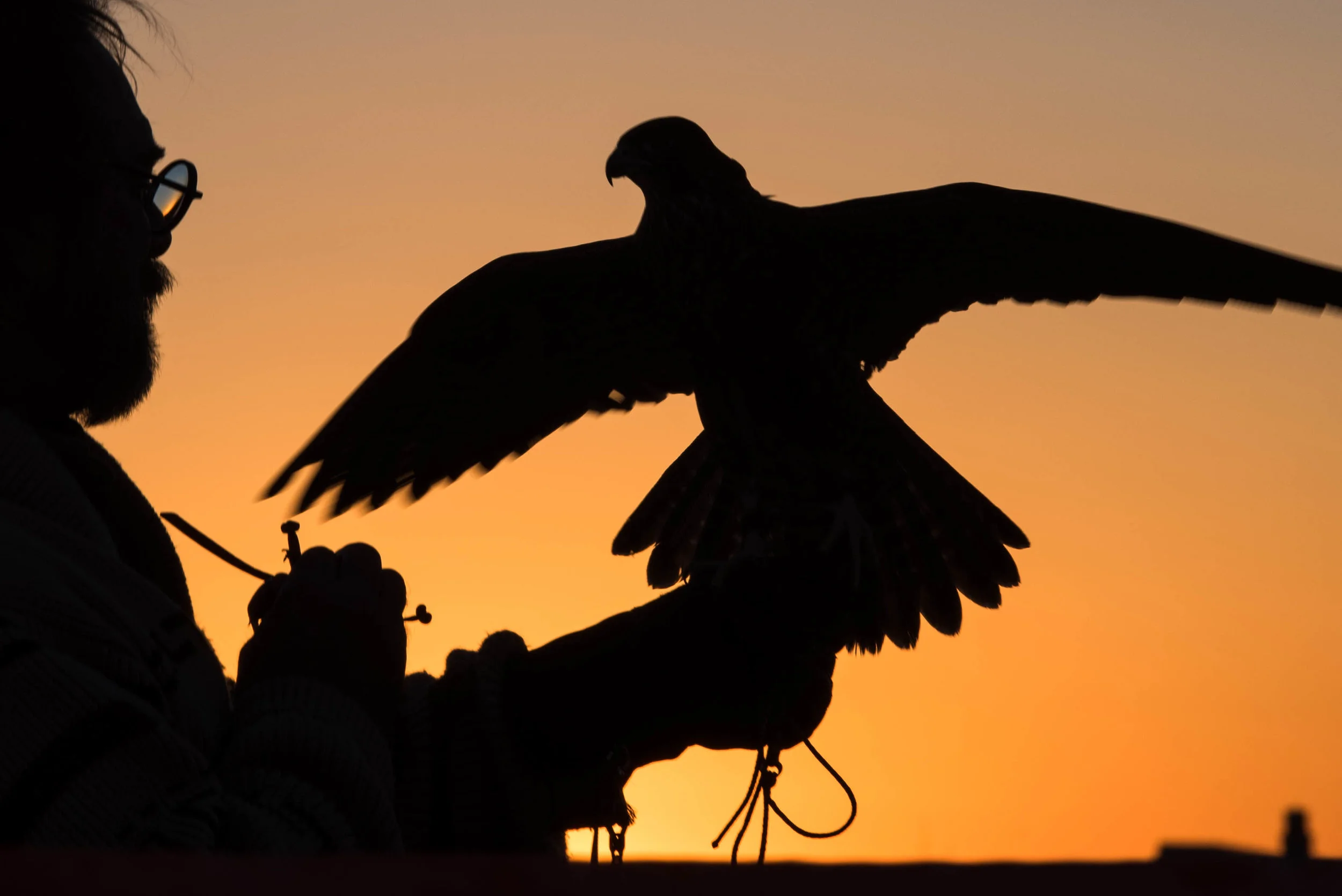
While in the U.S., falconers drive across the country chasing the season, hunting in deserts and snow, chasing a variety of game. In the south, the seasons are generally dry and the game includes water fowl and hares. But in the farther north, falconers will hunt in cold conditions, often in snow. American falconers will sometimes form caravans of RVs and campers, and camp on the plains of Wyoming to spend weeks hunting. They circle their vehicles, and form the closest thing you’ll find in America to the nomadic falconers from the Middle East. Except these falconers wear camo and Oakley sunglasses, and sport pistols on their hips. “They’re to shoot in the air and scare off eagles,” one of them says. “Eagles pose a serious threat to our birds.”
In 2016, UNESCO inscribed falconry as a living human heritage element, marking its cultural significance in more than a dozen countries. Falconry once stood as a symbol of status and nobility in medieval Europe. And depictions in stone carving and reliefs from the Middle East reveal an ancient appreciation for falconry. But it took more than 30 years to achieve the UNESCO status, somewhat due to the exclusive aristocratic connotation associated with falconry.
While falcons served as symbols of significance throughout world history, they are most notably associated with the cultures of central Asia, particularly Mongolia.
It is in Mongolia, on the steppes and in the mountains, that falconry is closest to its original roots. The Kazakhs, a Mongolian ethnic group, still practice traditional eagle-hunting. The Kazakhs reside in the mountainous steppe of Central Asia, where they fly eagles from horseback catching some of the largest quarries in falconry; fox, rabbit, pronghorn sheep, and even wolves.
The Kazakhs epitomize the symbiotic bond between man and beast that falconry represents. Falconers capture their eagles when they are only chicks, in order to imprint the young birds. They honor and revere their eagles, giving them noble names such as “King of Birds,” “Owner of the Steppe,” “Best Eagle,” and “Brighter Warrior.” Falconry remains a way of life for the Kazakhs, which is reflected in their veneration for the practice.
But falconers in the U.S. share this respect too. Originally, falconry was a mix of hunting and sport, the bird being a useful tool to aid in hunting, but also a beautiful object to be admired. And many of the most ardent American falconers make a pilgrimage to Mongolia to witness or participate in the traditional style.
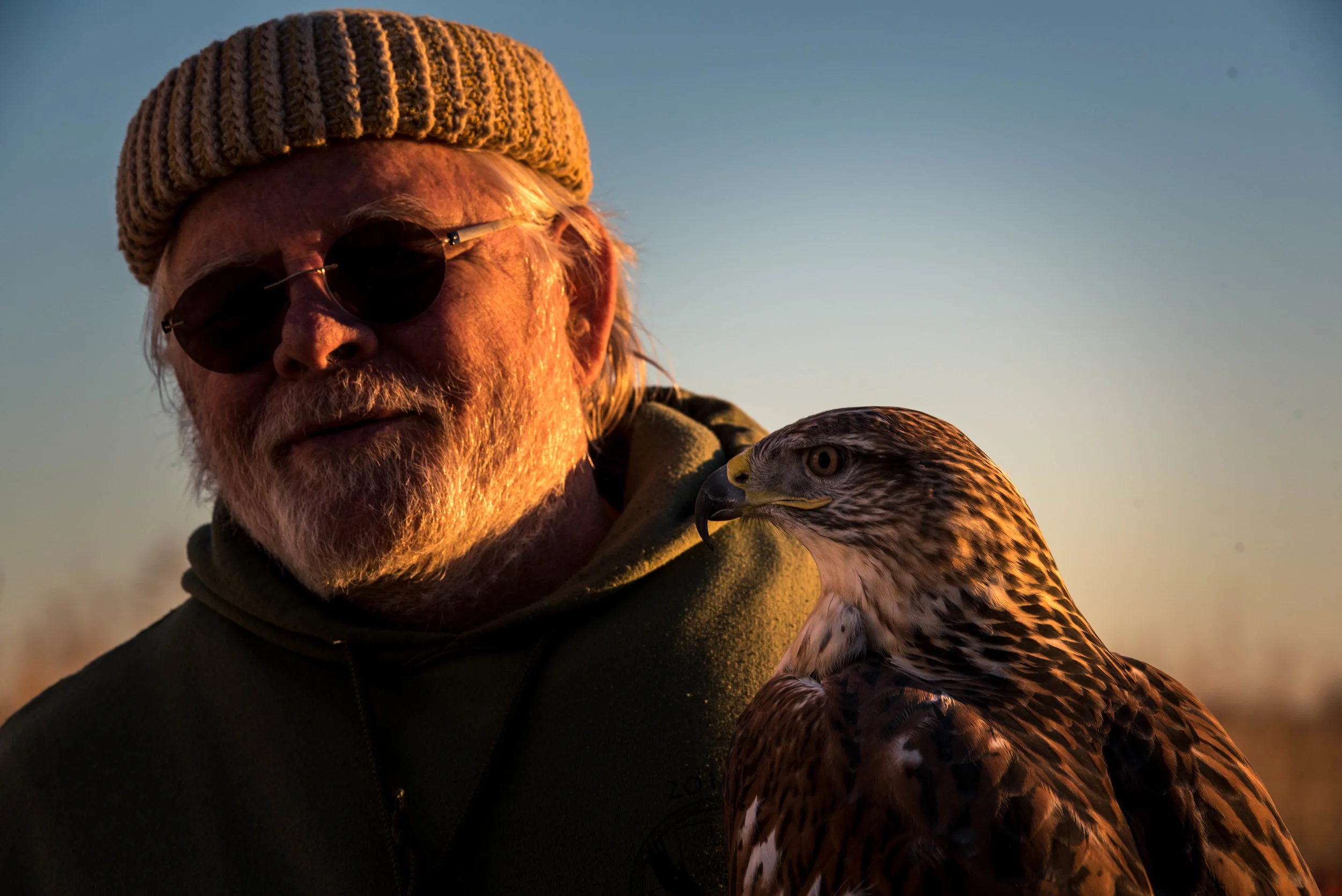
Doug Hegeman poses with his raptor outside the weathering yard during a falconry competition in Abilene, TX. Hegeman usually does his hunting on the prairies of Kansas, where the game consists of rabbits and small fowl.
Other than the technology, falconry hasn’t diverted all that much in its method. Its premise lies in its natural state, and the predatory instincts of the bird. Doug Hegeman, an old-time falconer from the plains of Kansas points out, “falconry occurs naturally whether humans are involved or not, we simply act as the chauffeurs bringing the birds to where the game is.” He adds that there is a pristine beauty in that.
He says this as he holds his hawk, a large beautiful bird, next to the weathering area during a massive falconry hunt in west Texas. When the birds aren’t hunting, falconers allow them to “weather,” setting them on a perch outside so they can rest in the sunlight.
Hegeman stands guard so that other predators or unwanted intruders do not disturb the birds. He holds his bird on his left hand, while texting on his iPhone with his other, pausing to say, “the irony of this isn’t lost on me. I’m essentially holding two pieces of technology; the bird is just a couple thousand years older than the iPhone.”

The Hunt
In the U.S., falconry largely exists as a blood sport – though the connotation that name conveys is somewhat misleading. Both Kessler and Hegeman are adamant to state that, essentially, they are observers of a natural phenomenon. The art is in the training and building a relationship with the bird. Kessler, who flies “double-gloved,” explains his method of using dogs and birds together during a hunt.
“There are very few things – aside from cattle ranching maybe – where you can get three different species working to accomplish one goal,” Kessler says as he pulls his SUV to a spot in the middle of a field – most falconry is done in open areas, such as dunes or plains, where a bird can fully utilize its cone of vision, flying high into the thermals to spot its prey.
Falcons have an eyesight 2-8 times more powerful than a human’s. They use this ability to track targets from vast distances, calculating the moment to strike. Raptors’ eyes illustrate their singular purpose in the hunt. Their forward facing eyes, called binocular vision, create a good perception of depth. This contrasts from prey animals, such as a deer, whose eyes are far apart to watch for predators sneaking up. Birds of prey act as heat-seeking missiles, targeting in on prey by bobbing their head back and forth to triangulate the position of its quarry. This gives a peculiar look to falcons when they are hooded, as they bob their heads back and forth, giving them an endearing look of curiosity.
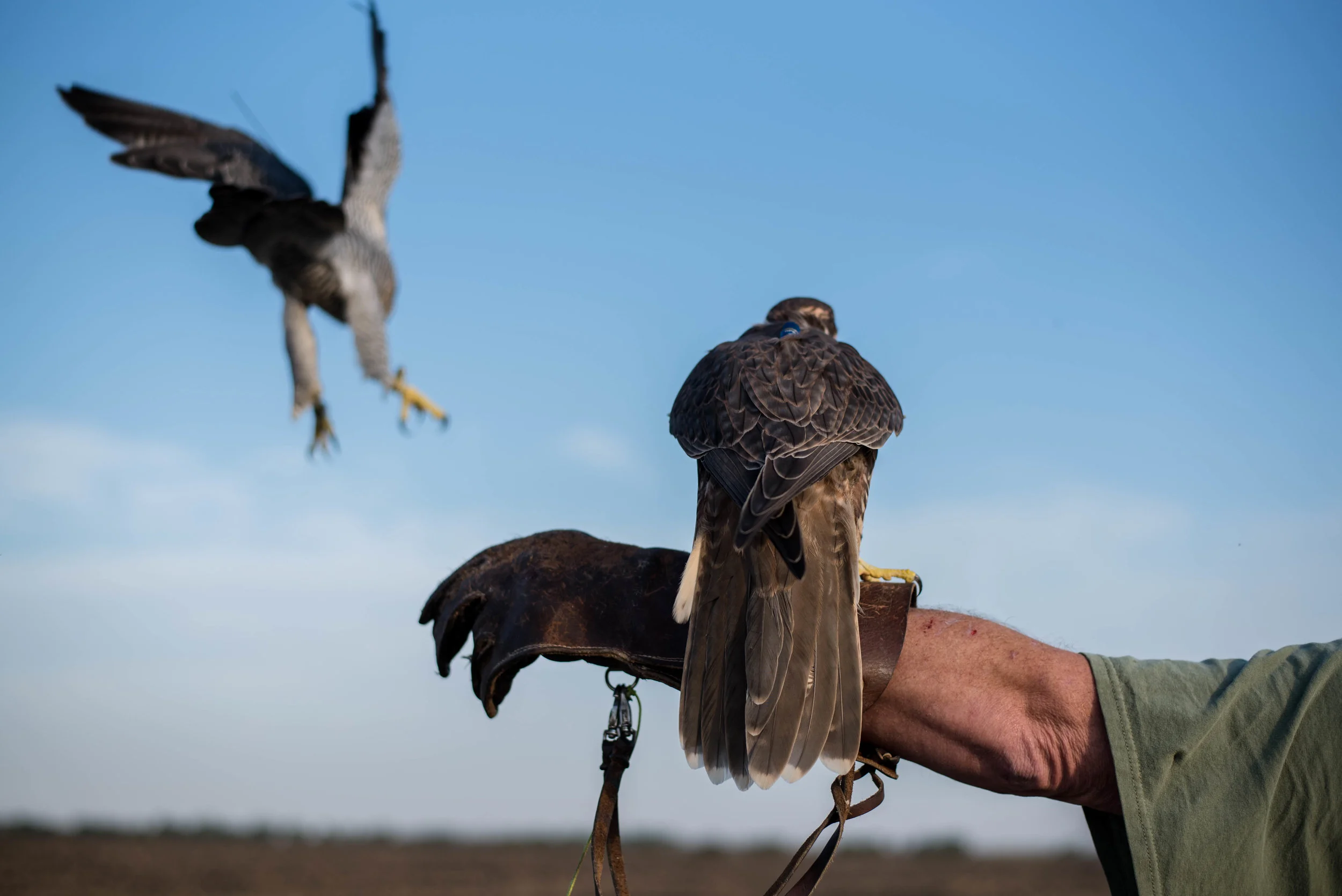
Kessler puts a GPS tracker on two of his birds, clipping the small telemetry device on the back of each. He flies male-female teams, and is one of the few falconers in the U.S. to fly two at a time. He puts a small male prairie hawk on his glove, and then the larger female. He removes the hood from each bird, and the two fly off in different directions, their small bodies exploding into a wingspan nearly a meter in length. The birds fly high into the blue until they are only specks you’d mistake for floaters in your eye. They reach a high altitude and rest their wings on the thermals.
He then moves swiftly back to the SUV and lets a whining Vizsla out of her kennel. The dog jumps down, circles once, and then goes straight to flushing the thicket, looking for any pheasant. The dog locks onto a scent and in an instant three pheasants fly out of the brush, staying low to the ground. Kessler lets out a high pitched whistle and the two falcons flying high above come soaring in from different directions. The pheasants fly low over the ground trying to gain speed, but the birds’ sharp vision marked the small fowl dead before it was more than three feet off the ground.
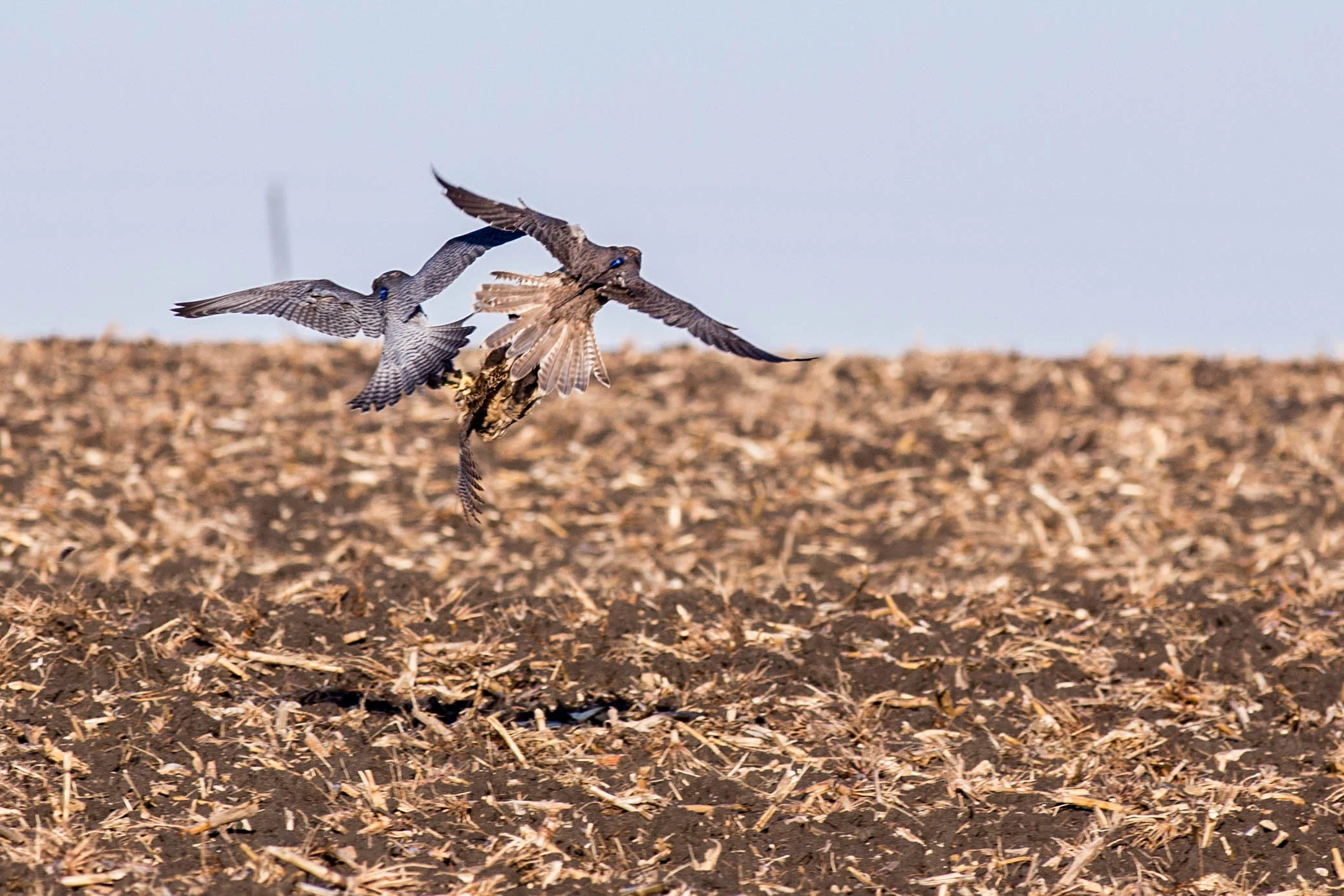
The two falcons fly in from different sides, their talons pulled to the front as they lean back on their wings, till they make contact, pinioning one of the pheasants between their combined talons. The collective mass of feathers and flesh falls, spinning to the ground.
Falcons and hawks have a sharp bone in their chest that is used to slam into prey. When keeping birds, falconers keep their birds’ weight down to maintain hunger and keep the bone sharp. “It’s where the expression, ‘he’s sharp,’ comes from,” Kessler says. A fully fed bird will sometimes sit on the glove, refusing to fly off. It is a reminder to the falconer of what drives the hunt – hunger. This is a sophisticated practice to keep the birds fed well enough to keep them healthy, without making them lethargic.
The time between the flush and kill is no more than a minute. The large female shrouds her kill under her wings as she begins to eat. When a bird does this, it is said to “mantle,” hiding its prey from view. It begins pulling sinews out of feathers with a sharp beak. The male hops on the ground a few feet away. Females are bigger than males and often the more dominant hunters. This is what allows Kessler to hunt two birds together, with a nuanced power dynamic between the two birds. Kessler pulls a piece of meat out of his bag and feeds the male on his glove.
“This is what a successful hunt looks like,” he says.
The Apprentice
Kessler has been a falconer for nearly a decade, giving him the designation “Master Falconer.” The path to becoming a falconer is rooted in a traditional apprenticeship.
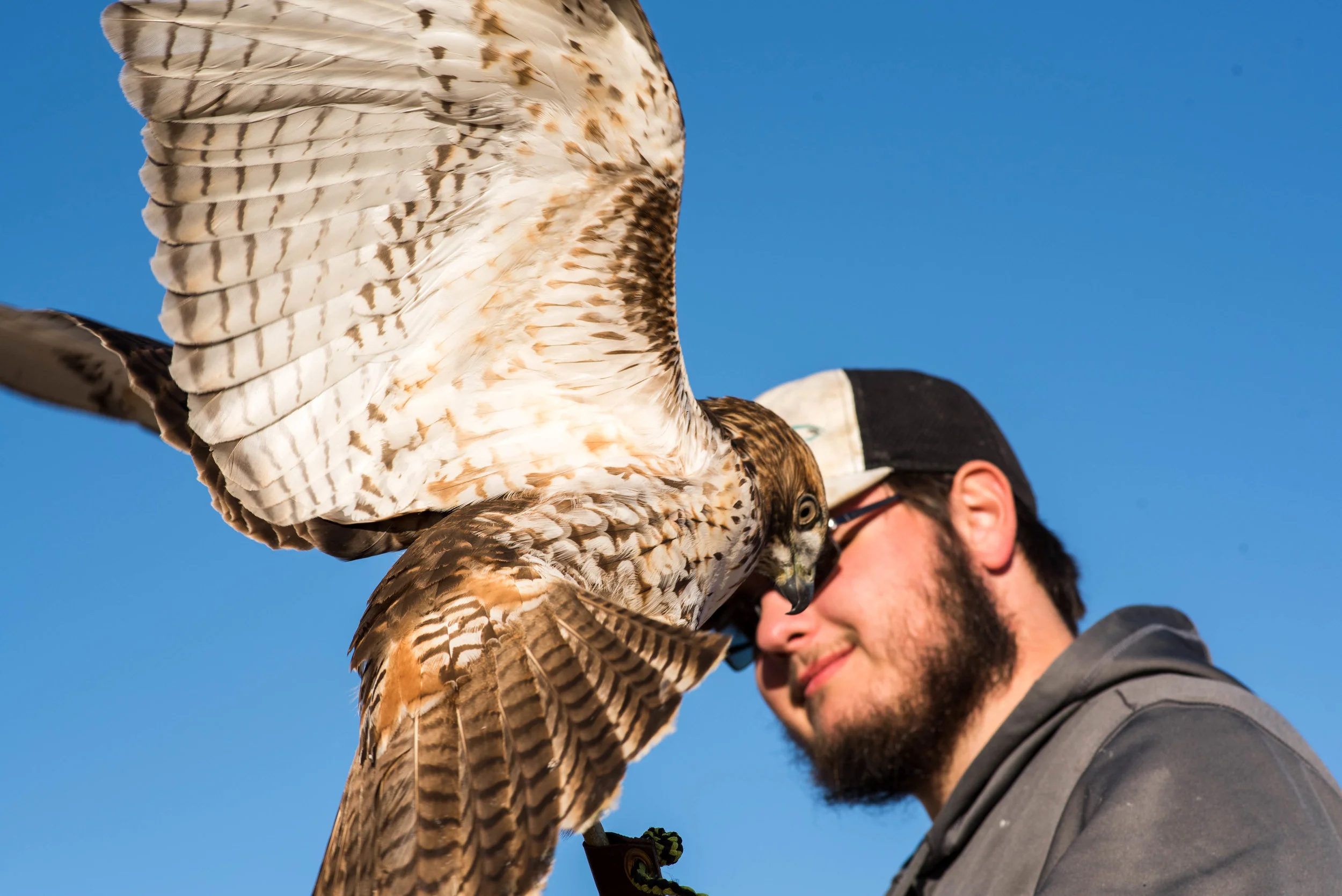
Hunter McBride, a teenager from outside Austin, TX, is an apprentice to Kessler. The apprenticeship process takes two years, and an apprentice must capture a falcon from the wild in order to hunt. It is only when they become an official falconer that they are able to buy or breed captive birds.
“Being an apprentice has had its troubles, but is also an eye-opening experience,” McBride says. The path to becoming a falconer is no easy task. “If we aren't careful, we can severely harm these amazing creatures and ultimately, kill them,” McBride says.
In order for an apprentice to begin, they must capture a raptor out of the wild. They cannot buy or be gifted a bird. This process creates a more intimate bond. The process of capturing a bird from the wild without causing harm takes patience and skill. “Some people ask that we don't reveal how birds are trapped to help protect these creatures from inexperienced people,” McBride says, adding to the esoteric nature of the apprenticeship.
Falconers usually build their own traps by hand, and drive along country roads searching for a place to set the trap. “I drove over 1000 miles to trap my Red-tailed Hawk, Azazel. I ended up trapping him around Abilene area with a mouse in a wire cage,” McBride says.
McBride must then work to build a connection with the wild bird. This is done through feeding. To eat out of a human hand shows a sense of trust and security in the bird. “The hardest part about training my bird was actually just getting him to trust me enough to eat around me. These are wild animals,” he explains. Falconers do not starve their birds, but rather control their weight in order to instill a trust, while keeping them hungry for a hunt.
“The bond comes with time and can’t be rushed,” McBride says.
McBride will be under Kessler’s mentorship for two years before he takes a test with Texas Parks and Wildlife. Falconry is closely regulated by the state, as with other forms of hunting in the U.S.
But even as a young apprentice, McBride is environmentally conscious. “If we over hunt an area or hunt too long into spring, we damage the populations of the game we are hunting,” he says, echoing the sentiment of many falconers, a concern for their natural surroundings.
Strange Tales of Falconry
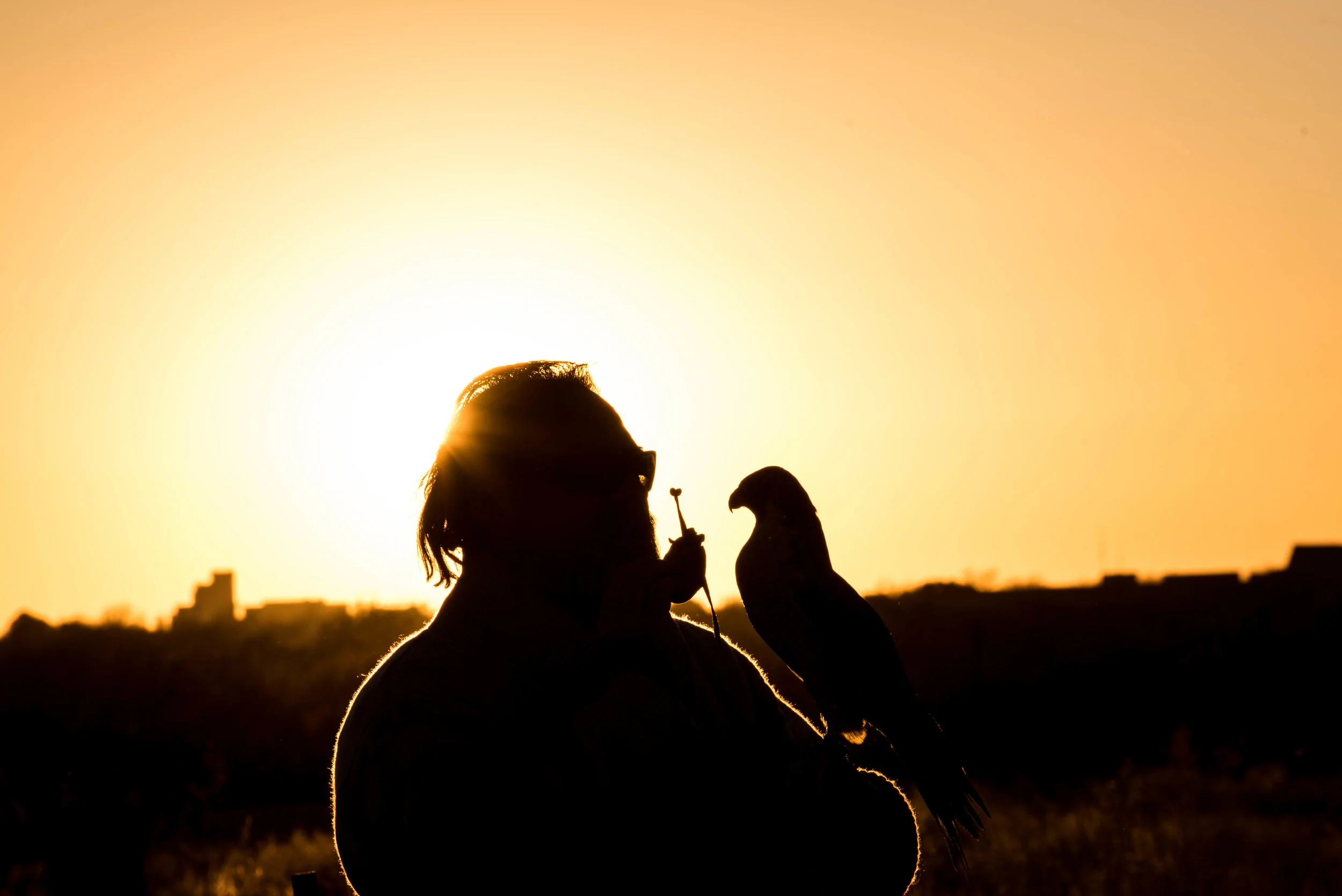
A key thing on every falconer’s mind is conservation, says Steve Duffy, a bird biologist who spends his time following the hunting season across the western U.S. Duffy is a large man with long hair pushed back, carrying an atmosphere likened to “The Dude” by almost everyone he meets.
Duffy’s work with falcons has led him all over the world, and even onto the set of some films.
“Yes, that was me,” he says over the roar of windows rolled down, “they gave me a small role in the movie, ‘The Falcon and the Snowman.’” He also worked with Arnold Schwarzenegger during the filming of the “Conan” movies, letting the Austrian bodybuilder fly hawks. He does his best Schwarzenegger impersonation as he roars down the Texas highway.
Duffy muses the relationship between humans and birds, and the strange beauty of imprinting as he drives two doctors from Florida on an empty road in west Texas. He is taking the two men to a duck pond, on a ranch about 40 miles outside Abilene. He’s acting as a guide for the two, taking them on a hunting tour of a ranch in west Texas
The drive passes an endless landscape of wind turbines, moving in slow, synchronous rotations. Duffy points out the window. “You know, people always talk about how many birds wind turbines kill a year, and the number sits at about 500,000 or 600,000 annually,” Duffy says. “And that sounds like a lot, but do you know how many birds domestic house cats kill annually? 1.5 billion.”
The conversation in the car turns to theories and the politics of house cats, and how a sinister plot to protect house cats – one of the most successful predators on the planet – poses a threat to the survival of bird populations. “Politicians love their cats,” Duffy says with concern, “and raptors are seen as a wild threat.”
One unifying theme among all falconers is a love for their bird. Paulo Coelho writes a tale of Genghis Kahn and his beloved falcon, where in a fit of rage, Kahn pierces the breast of his bird after it knocked his drinking cup from his hand as he tried to drink from a stream. It was only after the bird had died that he saw the dead snake that had poisoned the water. Upon realizing his bird had saved his life, he ordered a golden statue to be made in honor of his beloved friend.
“Yeah, I’ve heard that story,” Duffy says, flipping his sunglasses off his eyes for a moment. “The truth is, we bond with these birds, when you work together toward a common goal, it creates a sense of understanding.”
The drive takes them through rolling flatlands, perfect for falconry, where game like ground squirrels and rabbits roam, and the land is littered with duck ponds – also called “tanks.” This is the main game for falconers in this region. Anything bigger would require the strength that is reserved for the golden eagles of Mongolia.
He pulls the truck off the dirt road. They will walk the rest of the way so as not to startle the ducks. The bird is released into the air and the group moves quietly in a semi-circle to surround the pond, staying low behind the bank.
Ducks will hunker down on the water when a predator is flying high above, so the humans on the ground must flush them out. On his signal, Duffy motions to the group to move, arms out yelling to get the ducks airborne. The nearly 50 ducks fly off in a swarm and the hawk flies through the mass, missing its target.
Duffy helps the doctor lure his bird back in, and hoods it. “It takes years of practice to have a successful hunt,” Duffy says, “you need to learn the skills but also the personality of your bird.” The men walk back to the truck, dejected. But Duffy stands in quiet excitement, admiring the landscape. His eyes brighten and he silently points out a wild eagle flying over a lake in the distance.
Falconry is a sport, an art, and sometimes a means of sustenance. The majority of falconers in the U.S. practice as a hobby, a niche activity that at the surface serves as interesting party talk. But by performing in the symbiotic relationship between man and wild animal, they continue a tradition that has long tied humans to our primeval roots. The carnal hunt, death as a means of survival. Seeing a falcon kill its prey is a subconscious reminder of where we come from, a secret tie to the wild from which we are only a few steps removed.